Future of Online Learning: 6 Trends Shaping US Higher Ed

Latest developments on The Future of Online Learning: 6 Trends Shaping US Higher Education in the Next 3 Years (RECENT UPDATES), with key facts, verified sources and what readers need to monitor next in Estados Unidos, presented clearly in Inglês (Estados Unidos) (en-US).
The Future of Online Learning: 6 Trends Shaping US Higher Education in the Next 3 Years (RECENT UPDATES) is shaping today’s agenda with new details released by officials and industry sources. This update prioritizes what changed, why it matters and what to watch next, in a straightforward news format.
The Evolving Landscape of US Higher Education
The academic world in the United States is undergoing a profound transformation, with online learning at its epicenter. Institutions are actively adapting their strategies to meet the changing demands of students and the workforce.
This shift is not merely a reaction to recent global events but a strategic pivot towards more flexible and accessible educational models. The integration of technology continues to redefine pedagogical approaches and student engagement.
Understanding these emerging trends is crucial for anyone involved in higher education, from policymakers to prospective students. The trajectory of online education will significantly influence future career paths and societal development.
Trend 1: Personalized Learning Pathways
Personalized learning is rapidly gaining traction as educators seek to cater to individual student needs and learning styles. This approach leverages data analytics and adaptive technologies to create customized educational experiences.
The goal is to move away from a one-size-fits-all model, allowing students to progress at their own pace and focus on areas most relevant to their career aspirations. This method promises to enhance engagement and improve learning outcomes significantly.
As institutions invest more in AI-driven platforms, the ability to tailor curricula and provide targeted support will become a cornerstone of effective online instruction. This individualized approach is central to the future of online learning in US higher education.
Adaptive Learning Technologies
Adaptive learning systems utilize artificial intelligence to adjust content and difficulty levels based on a student’s performance and learning patterns. These systems identify knowledge gaps and provide immediate, relevant feedback.
Such technologies enable instructors to monitor student progress in real-time, allowing for timely interventions and personalized guidance. The effectiveness of these tools lies in their capacity to make learning more efficient and relevant for each student.
Competency-Based Education (CBE)
- CBE focuses on demonstrating mastery of specific skills and knowledge rather than seat time.
- Students advance once they prove proficiency, regardless of how long it takes.
- This model is particularly appealing for adult learners and those seeking career advancement.
Trend 2: AI and Automation in Course Delivery
Artificial intelligence and automation are no longer futuristic concepts but integral components of modern online learning environments. These technologies are streamlining administrative tasks and enhancing instructional design.
AI-powered tools can grade assignments, provide instant feedback, and even act as virtual tutors, freeing up instructors to focus on more complex teaching and mentorship roles. This integration is boosting efficiency and scalability in educational delivery.
The continued evolution of AI will further personalize learning experiences and make education more accessible to a broader audience. The role of AI in shaping the future of online learning in US higher education cannot be overstated.
AI-Powered Tutoring and Support
Virtual assistants and chatbots are increasingly being deployed to offer 24/7 support to students, answering common questions and guiding them through course materials. This immediate assistance can significantly reduce student frustration and improve retention rates.
These tools are designed to complement human interaction, not replace it, ensuring students receive consistent and reliable support. The continuous improvement of natural language processing makes these interactions increasingly sophisticated and helpful.
Automated Assessment and Feedback
- Automated systems can evaluate various types of assignments, from essays to coding projects.
- They provide consistent, objective feedback, reducing grading bias and turnaround times.
- This allows instructors to focus on qualitative feedback and deeper student engagement.
Trend 3: The Rise of Micro-credentials and Stackable Programs
The demand for flexible, career-focused education has led to a surge in micro-credentials and stackable programs. These shorter, specialized certifications allow individuals to acquire specific skills quickly and efficiently.
Unlike traditional degrees, micro-credentials are often focused on workforce development, making them highly attractive to professionals seeking to upskill or reskill. This modular approach to education offers greater agility in a rapidly changing job market.
Universities are partnering with industry leaders to develop relevant programs, ensuring that the skills taught are directly applicable to current industry needs. This trend is a significant part of the future of online learning in US higher education.
Industry-Aligned Certifications
Many institutions are collaborating with corporations to create certifications that directly address skill gaps in specific industries. These programs often incorporate real-world projects and case studies, preparing students for immediate employment.
The value of these certifications lies in their direct relevance to employers, providing a clear path from learning to employment. This responsiveness to market demands is crucial for maintaining a competitive edge in education.
Stackable Learning Modules
- Students can earn multiple micro-credentials that can be combined to form a larger degree or qualification.
- This provides flexibility, allowing learners to build their education incrementally.
- It also reduces the financial burden, as students can pay for smaller, more manageable units of study.
Trend 4: Global Collaboration and Cross-Institutional Partnerships
Online learning inherently transcends geographical boundaries, fostering unprecedented opportunities for global collaboration. Universities are increasingly forming partnerships with international institutions to offer joint programs and shared resources.
These collaborations enrich the learning experience by exposing students to diverse perspectives and cultures, preparing them for a globally interconnected workforce. It also allows institutions to pool their expertise and expand their reach.
Such partnerships are vital for creating a more inclusive and comprehensive educational ecosystem. This global outreach is a defining characteristic of the future of online learning in US higher education.
International Exchange Programs Online
Virtual exchange programs allow students to collaborate with peers from around the world without the need for physical travel. These programs often involve joint projects, discussions, and cultural exchanges.
The accessibility of online platforms makes these exchanges more feasible for a wider range of students, promoting cross-cultural understanding and teamwork. This broadens horizons and develops essential global competencies.
Shared Resources and Faculty Expertise
- Partner institutions can share specialized faculty members and unique course offerings.
- This expands the curriculum options available to students at each institution.
- It also promotes a global academic community, fostering research and innovation across borders.
Trend 5: Immersive Technologies (VR/AR) in Education
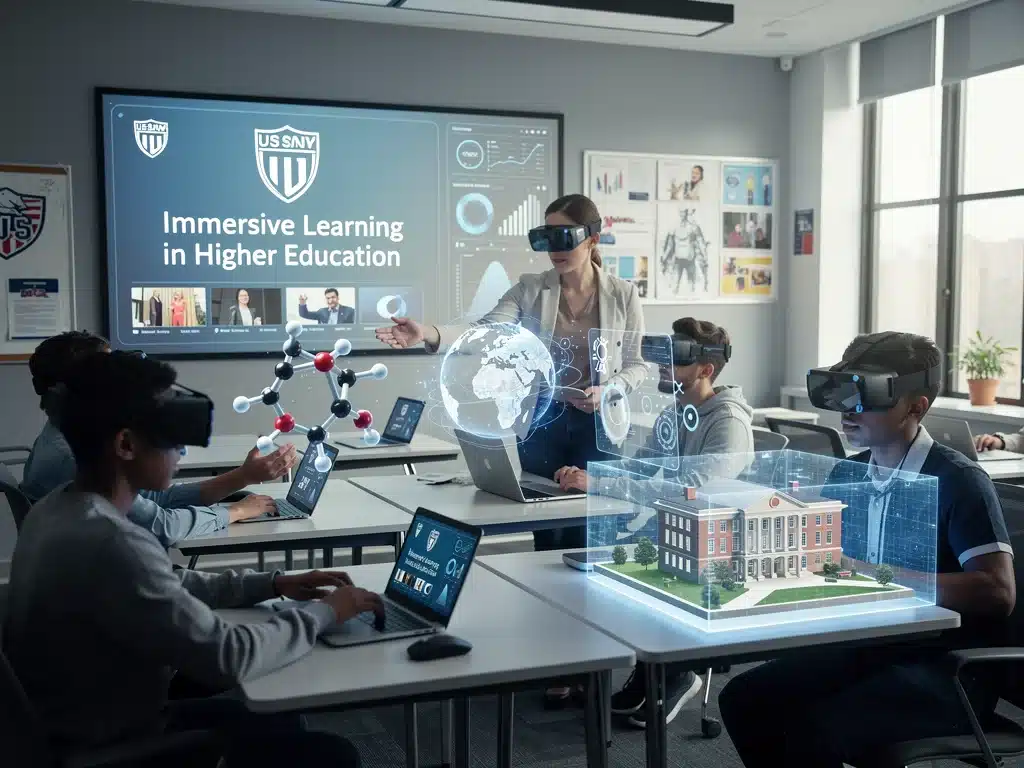
Virtual Reality (VR) and Augmented Reality (AR) are poised to revolutionize online learning by creating highly immersive and interactive educational experiences. These technologies offer dynamic ways to engage with complex subjects.
From virtual lab simulations to historical site explorations, VR and AR can transport students to environments that would otherwise be inaccessible. This hands-on, experiential learning significantly enhances comprehension and retention.
As the cost of these technologies decreases and their accessibility increases, their integration into online curricula will become more widespread. Immersive technologies represent a significant leap forward for the future of online learning in US higher education.
Virtual Field Trips and Simulations
VR allows students to embark on virtual field trips to remote locations, historical sites, or even human anatomy, providing experiences that were previously impossible in a traditional classroom setting. Simulations offer safe and repeatable environments for practical training.
These immersive experiences make abstract concepts tangible and memorable, improving critical thinking and problem-solving skills. The ability to interact with complex models in three dimensions transforms understanding.
Augmented Reality for Interactive Learning
- AR overlays digital information onto the real world, enhancing textbooks and physical objects.
- Students can use their smartphones or tablets to interact with augmented content.
- This technology provides an engaging way to visualize complex data and concepts in a familiar environment.
Trend 6: Hybrid Learning Models and Blended Campuses
The concept of hybrid learning, which combines online and in-person instruction, is becoming a dominant model in US higher education. This approach offers the best of both worlds, providing flexibility while retaining the benefits of face-to-face interaction.
Institutions are redesigning their physical campuses to support these blended models, creating collaborative spaces that facilitate both online and offline engagement. This adaptability caters to a broader range of student preferences and circumstances.
The continued refinement of hybrid models will ensure that education remains resilient and responsive to future disruptions. This flexible design is crucial for the future of online learning in US higher education.
Flexible Course Delivery
Hybrid courses allow students to choose how they engage with course material, whether through live online sessions, recorded lectures, or in-person classes. This flexibility accommodates diverse schedules and learning preferences.
This model empowers students to take ownership of their learning journey, balancing academic pursuits with personal and professional commitments effectively. It also broadens access for non-traditional students.
Redesigned Campus Spaces
- Physical campuses are being reconfigured to serve as hubs for collaboration and specialized resources.
- Spaces are being equipped with advanced technology to support blended learning activities.
- This creates a dynamic environment where online and in-person learning seamlessly intersect.
The Impact on Faculty and Student Support
These evolving trends in online learning necessitate significant adjustments for both faculty and student support services. Educators require ongoing professional development to master new technologies and pedagogical approaches.
Universities are investing in training programs to equip faculty with the skills needed to design and deliver effective online and hybrid courses. This ensures that the quality of instruction remains high, regardless of the delivery method.
Furthermore, student support services, including academic advising, mental health resources, and technical assistance, are being adapted to meet the unique needs of online learners. The future of online learning in US higher education depends on robust support systems.
Professional Development for Educators
Faculty training focuses on best practices for online engagement, effective use of learning management systems, and integrating AI and immersive technologies. This continuous learning ensures educators can maximize the potential of digital tools.
Workshops and certifications help instructors develop new skills, fostering a culture of innovation and adaptability within academic departments. This investment in human capital is as important as technological upgrades.
Enhanced Student Services
- Online tutoring, virtual office hours, and digital counseling services are becoming standard offerings.
- IT support is critical for troubleshooting technical issues and ensuring seamless access to platforms.
- These services aim to create a supportive and inclusive environment for all learners, regardless of location.
Challenges and Opportunities Ahead
While the future of online learning in US higher education presents immense opportunities, it also comes with notable challenges. Ensuring equitable access to technology and high-speed internet remains a critical concern, particularly for underserved populations.
Maintaining academic integrity in remote environments requires innovative solutions and robust proctoring technologies. Furthermore, institutions must continuously adapt their curricula to remain relevant in a rapidly changing global economy.
Despite these hurdles, the potential for online learning to democratize education and foster lifelong learning is immense. Strategic planning and continuous innovation will be key to navigating this dynamic landscape successfully.
Addressing Digital Equity
Efforts are underway to bridge the digital divide, providing resources and support to students who lack access to necessary technology or reliable internet. This includes device lending programs and partnerships with community organizations.
Ensuring that all students have equal opportunities to participate in online learning is fundamental to its long-term success and ethical implementation. This commitment to equity is paramount.
Ensuring Academic Integrity
- Advanced proctoring software uses AI to monitor student behavior during online exams.
- Plagiarism detection tools are continuously updated to identify academic misconduct.
- Educators are also designing assessments that emphasize critical thinking and application, making cheating more difficult.
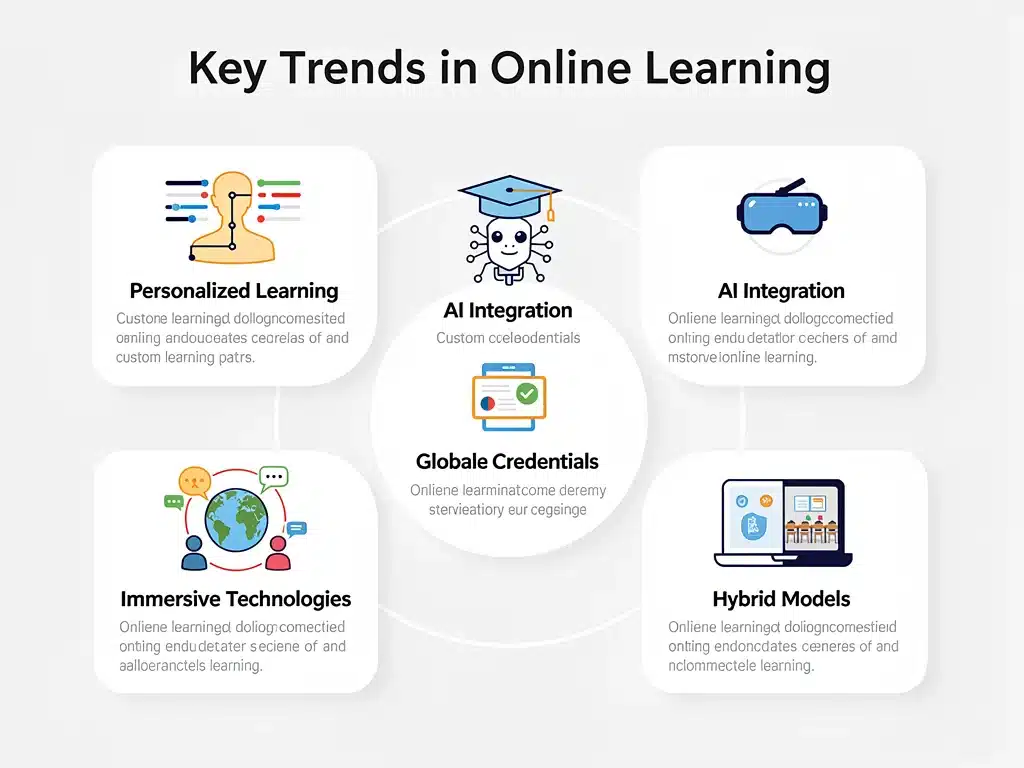
| Key Trend | Brief Description |
|---|---|
| Personalized Learning | Customized educational experiences via adaptive tech and data. |
| AI & Automation | Streamlining tasks and enhancing instruction with intelligent systems. |
| Micro-credentials | Short, career-focused certifications for rapid skill acquisition. |
| Immersive Tech | VR/AR for engaging, experiential learning environments. |
Frequently Asked Questions About Online Learning Trends
Personalized learning tailors educational content and pace to individual student needs, often using AI and data analytics. This approach aims to optimize engagement and outcomes by adapting to each learner’s unique style and prior knowledge, a key aspect of the future of online learning in US higher education.
AI will automate administrative tasks, provide instant student feedback, and offer personalized tutoring. This frees educators to focus on complex teaching, enhancing efficiency and scalability in online education. AI is transforming the future of online learning in US higher education by making it more adaptive and responsive.
Micro-credentials are short, specialized certifications focused on specific skills, often developed with industry partners. They are important because they offer flexible, career-oriented learning paths, allowing individuals to quickly upskill or reskill for the evolving job market, a critical component of the future of online learning in US higher education.
Immersive technologies like VR and AR create highly interactive and experiential learning environments. They enable virtual field trips, simulations, and augmented content, making complex subjects more engaging and comprehensible for students, profoundly shaping the future of online learning in US higher education.
Hybrid learning combines online and in-person instruction, offering flexibility and the benefits of face-to-face interaction. This model allows students to choose their engagement methods, while campuses are redesigned to support blended activities, making it a cornerstone of the future of online learning in US higher education.
Perspectives
The trends discussed underscore a dynamic period for education, where adaptation and innovation are paramount. Institutions must continue to invest in technology, faculty development, and student support services to remain competitive and relevant.
Monitoring the implementation of these changes and their long-term effects on student success and workforce readiness will be crucial. The ability to embrace these shifts will define the leaders in the evolving educational landscape.
Ultimately, the Future Online Learning US will be characterized by greater accessibility, personalization, and a stronger alignment with the demands of a globalized, digital economy. The next three years promise transformative developments for all stakeholders.