Disability Benefits 2026: SSDI vs. SSI – Which is Right for You?

Understanding Disability Benefits 2026 is crucial for those seeking support. This report provides a detailed comparison of SSDI and SSI, outlining eligibility, benefits, and application processes for each program. Readers will gain clear insights to determine which disability benefit is the right fit for their individual circumstances in the coming year.
Disability Benefits 2026: A Comparison of SSDI vs. SSI and Which Is Right For You (COMPARISON/ANALYSIS) is a critical topic for many Americans facing health challenges that prevent them from working. As we approach 2026, understanding the nuances between Social Security Disability Insurance (SSDI) and Supplemental Security Income (SSI) becomes even more vital for potential applicants.
This comprehensive guide aims to demystify these two federal programs, providing a clear, factual, and up-to-date comparison. Our objective is to equip you with the necessary information to make informed decisions about your financial future and access the support you deserve.
Understanding the Foundations of Disability Benefits 2026
The Social Security Administration (SSA) manages two primary programs designed to provide financial assistance to individuals with disabilities: Social Security Disability Insurance (SSDI) and Supplemental Security Income (SSI). While both offer crucial support, they operate under distinct eligibility criteria and benefit structures, making a clear understanding essential.
For those navigating the complexities of Disability Benefits 2026, recognizing the fundamental differences between these programs is the first step toward a successful application. These distinctions often dictate which program an individual qualifies for, and subsequently, the type and amount of aid they receive.
It is important to note that a person may qualify for one, both, or neither of these programs, depending on their unique circumstances. This guide will help clarify these pathways as we look towards Disability Benefits 2026.
SSDI: Eligibility and Work Credits for 2026
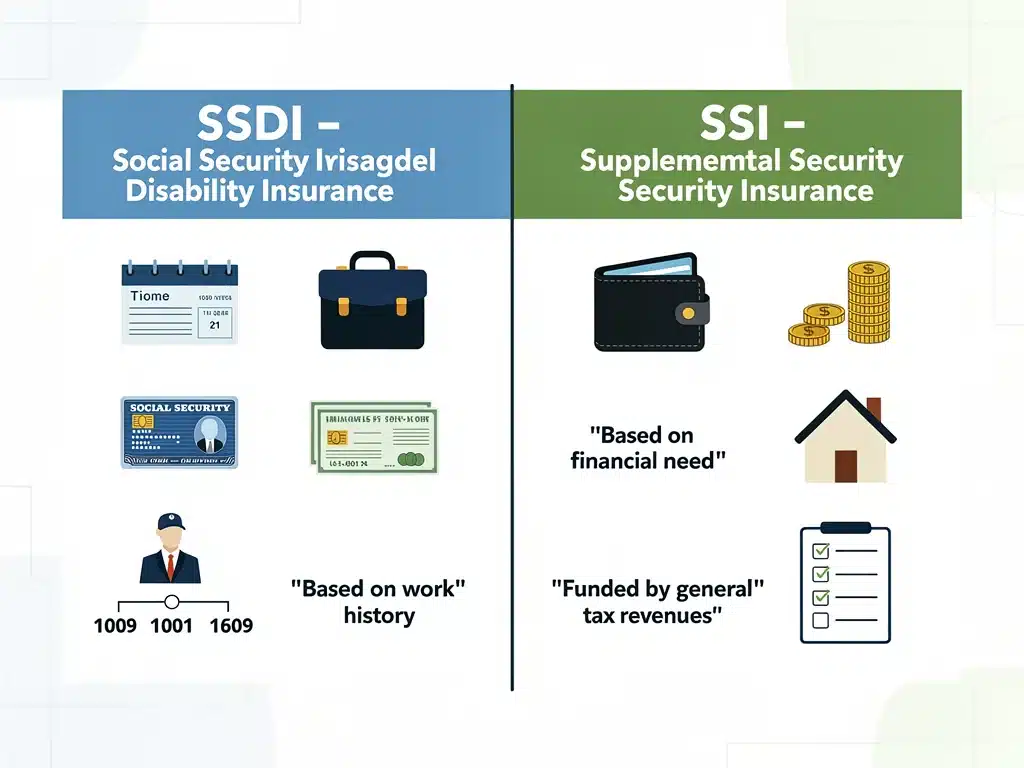
Social Security Disability Insurance (SSDI) is a federal insurance program that pays benefits to you and certain members of your family if you are “insured,” meaning you have worked long enough and paid Social Security taxes. Your eligibility for SSDI is directly tied to your work history and the accumulation of what are known as “work credits.”
To qualify for SSDI in Disability Benefits 2026, most adults need to have earned 20 work credits in the last 10 years, ending with the year their disability began. A maximum of four work credits can be earned each year, meaning you generally need to have worked for at least five out of the last ten years.
The specific number of work credits required can vary depending on your age when your disability began. Younger workers may qualify with fewer credits. This system ensures that those who have contributed to the Social Security system through their employment are covered if they become unable to work.
The Role of Work Credits in SSDI
- Earning Credits: You earn work credits by working and paying Social Security taxes on your earnings. In 2026, the amount of earnings required for one credit will likely be adjusted for inflation.
- Required Credits: The number of credits needed for SSDI depends on your age at the time your disability began. For example, if you become disabled at age 31 or older, you generally need 20 credits in the 10 years before your disability.
- Credit Accumulation: It is possible to earn up to four credits each year. This means a consistent work history is key to building eligibility for Disability Benefits 2026 through SSDI.
Impact of Age on SSDI Eligibility
- Younger Workers: Individuals who become disabled at a younger age may qualify with fewer work credits. The SSA has specific rules that account for limited work history in these cases.
- Older Workers: Those who become disabled later in life typically need a more extensive work history, often requiring the full 20 credits within the last decade.
- Work History Review: The SSA will thoroughly review your earnings record to determine if you meet the work credit requirements, which is a crucial step in the application process for Disability Benefits 2026.
SSI: Income and Resource Limits for 2026
Supplemental Security Income (SSI) is a needs-based program that provides cash assistance to aged, blind, and disabled individuals who have limited income and resources. Unlike SSDI, eligibility for SSI is not based on your work history or Social Security taxes paid.
Instead, SSI focuses on your current financial situation, specifically your income and assets. For Disability Benefits 2026, strict limits will apply to both, meaning that even if you have a severe disability, you might not qualify if your financial resources exceed the established thresholds.
These limits are designed to ensure that the program primarily serves those with the most significant financial need. Understanding these income and resource tests is paramount when considering SSI as part of your Disability Benefits 2026 strategy.
Defining Income for SSI in 2026
When the SSA evaluates your income for SSI purposes, they consider several types of earnings, but not all income counts equally. Earned income, such as wages, is treated differently from unearned income, like pensions or other benefits. Certain types of income are also excluded entirely.
For Disability Benefits 2026, understanding these distinctions is key to accurately assessing your eligibility. The SSA applies various exclusions and deductions to your gross income to arrive at your “countable income,” which is then compared against the federal benefit rate.
Navigating these rules can be complex, and even small amounts of income can affect your eligibility or benefit amount. It’s essential to report all income accurately to the SSA to avoid potential issues.
Resource Limits and Exclusions for SSI
In addition to income, your resources (assets) are also evaluated for SSI eligibility. For Disability Benefits 2026, the resource limit for an individual is typically $2,000, and for a couple, it is $3,000. These limits apply to assets that can be converted to cash to pay for food or shelter.
However, not all assets are counted. Common exclusions include your primary residence, one vehicle (if used for transportation), household goods, and personal effects. Certain other assets, like funds set aside for a Plan to Achieve Self-Support (PASS), can also be excluded.
Properly identifying and documenting your countable resources is a critical step in the SSI application process. Misunderstanding these rules can lead to denial of benefits, even if you meet all other criteria for Disability Benefits 2026.
The Disability Definition: A Common Ground for Both Programs
While SSDI and SSI have different financial and work history requirements, they share a fundamental commonality: the definition of disability. To qualify for either program, you must meet the Social Security Administration’s strict definition of disability, which is the same for both.
This definition requires that you have a severe medical condition that has lasted or is expected to last at least 12 months, or result in death, and that prevents you from performing substantial gainful activity (SGA). The medical evidence you provide is paramount in proving your disability for Disability Benefits 2026.
The SSA uses a five-step sequential evaluation process to determine if you are disabled. This process assesses your work activity, the severity of your medical condition, whether your condition meets a listed impairment, your ability to do past work, and your ability to do any other type of work. This consistency in the disability definition streamlines the medical review for both SSDI and SSI applicants.
Application Process and Medical Review for Disability Benefits 2026
The application process for both SSDI and SSI involves several stages, beginning with an initial application to the Social Security Administration. This is followed by a thorough medical review conducted by state agencies, often referred to as Disability Determination Services (DDS).
Regardless of whether you apply for SSDI or SSI, the medical review component is identical. You will need to provide extensive medical documentation, including diagnoses, treatment records, and opinions from your treating physicians, to support your claim for Disability Benefits 2026.
This phase is often the most challenging part of the application, as the SSA’s definition of disability is very stringent. Applicants should be prepared to provide as much detailed medical evidence as possible to demonstrate how their condition limits their ability to work.
Navigating the Initial Application
- Online Application: Many applicants begin by applying online through the SSA website, which provides a convenient way to submit initial information.
- Required Information: Be prepared to provide personal details, work history (for SSDI), income and resource information (for SSI), and extensive medical records.
- Accuracy is Key: Ensuring all information is accurate and complete can significantly impact the speed and outcome of your application for Disability Benefits 2026.
The Role of Medical Evidence
- Comprehensive Records: Gather all relevant medical records, including doctor’s notes, lab results, imaging reports, and hospital stays.
- Doctor’s Statements: Strong statements from your treating physicians detailing your limitations and prognosis are highly valuable.
- Consistency: The medical evidence should consistently demonstrate how your condition meets the SSA’s definition of disability, crucial for securing Disability Benefits 2026.
Benefit Amounts and Healthcare Coverage in 2026
The financial benefits and associated healthcare coverage differ significantly between SSDI and SSI. These differences are a major factor in determining which program is more suitable for an individual’s needs, particularly when planning for Disability Benefits 2026.
SSDI benefits are based on your average lifetime earnings before your disability began, meaning the amount can vary widely among recipients. SSI benefits, on the other hand, are a standardized federal benefit rate, with potential state supplements.
Healthcare coverage is also distinct: SSDI recipients generally become eligible for Medicare after a waiting period, while SSI recipients typically qualify for Medicaid immediately. This distinction is critical for long-term health planning and access to necessary medical care under Disability Benefits 2026.
SSDI Benefit Calculation and Medicare Access
Your SSDI benefit amount is calculated based on your average indexed monthly earnings (AIME) over your working life. This means that individuals who earned more and paid more Social Security taxes generally receive higher monthly benefits. The SSA provides a benefit calculator on its website to estimate potential payments.
For healthcare, SSDI recipients are usually eligible for Medicare after a 24-month waiting period from their entitlement date to disability benefits. This waiting period can be a significant concern for those requiring immediate comprehensive medical coverage, making it a key consideration for Disability Benefits 2026 planning.
It’s important to understand that Medicare eligibility through SSDI does not begin immediately, and applicants should plan for their healthcare needs during this waiting period.
SSI Benefit Structure and Medicaid Eligibility
SSI provides a federal monthly benefit that is standardized across the country, though some states offer supplemental payments. The federal benefit rate (FBR) for Disability Benefits 2026 will likely be adjusted for inflation, providing a baseline for recipients.
A significant advantage of SSI is the immediate eligibility for Medicaid in most states. This means that once approved for SSI, individuals typically gain access to comprehensive healthcare coverage without a waiting period, which is crucial for many low-income disabled individuals.
The combination of direct financial assistance and immediate healthcare access makes SSI a vital safety net for those with limited means. This immediate access to healthcare can be a deciding factor for many applicants considering Disability Benefits 2026.
Concurrent Benefits: Qualifying for Both SSDI and SSI
It is possible for an individual to qualify for both Social Security Disability Insurance (SSDI) and Supplemental Security Income (SSI) simultaneously. This situation, often referred to as “concurrent benefits,” occurs when a person meets the eligibility requirements for both programs.
Typically, this happens when an individual is approved for SSDI, but their benefit amount is very low, falling below the SSI federal benefit rate. In such cases, SSI can supplement the SSDI payment to bring the total monthly income up to the SSI FBR, plus any state supplements.
Understanding the potential for concurrent benefits is important for maximizing financial support under Disability Benefits 2026. The SSA will automatically evaluate eligibility for both programs if you apply for one and appear to meet the criteria for the other, simplifying the application process.
Which Program is Right for You in 2026?
Determining whether SSDI, SSI, or both are the right fit for your situation in Disability Benefits 2026 requires a careful evaluation of your work history, current income, and resources. There is no one-size-fits-all answer, as eligibility is highly individualized.
If you have a substantial work history and have paid into Social Security, SSDI is likely your primary consideration. If you have limited work history, or your income and resources are very low, SSI might be the more appropriate path for securing Disability Benefits 2026.
Many individuals find it beneficial to consult with a disability advocate or attorney who specializes in Social Security law. These professionals can help assess your eligibility, navigate the complex application process, and represent you in appeals if necessary, ensuring you pursue the correct program for your needs.
Key Considerations for Your Choice
- Work History: Your employment record and the amount of Social Security taxes paid are crucial for SSDI eligibility.
- Financial Need: Your current income and assets are the primary determinants for SSI qualification.
- Healthcare Needs: Consider whether immediate Medicaid (SSI) or eventual Medicare (SSDI) better suits your medical coverage requirements for Disability Benefits 2026.
Seeking Professional Guidance
- Disability Attorneys: Lawyers specializing in Social Security disability can provide expert advice on your specific situation and help with the application.
- Advocacy Groups: Various organizations offer support and resources for individuals applying for disability benefits, guiding them through the complexities of Disability Benefits 2026.
- SSA Resources: The Social Security Administration website and local offices offer valuable information and assistance during the application process.

Appeals Process for Denied Disability Benefits 2026 Claims
Receiving a denial for Disability Benefits 2026 can be disheartening, but it is not uncommon, and it is certainly not the end of the process. The Social Security Administration has a multi-tiered appeals process that allows applicants to challenge unfavorable decisions.
This process includes several stages: reconsideration, a hearing by an administrative law judge (ALJ), review by the Appeals Council, and finally, federal court review. Each stage offers an opportunity to present new evidence or arguments in support of your disability claim.
Understanding and effectively navigating the appeals process is crucial for many individuals seeking to secure their Disability Benefits 2026. Many successful claims are ultimately approved at the reconsideration or ALJ hearing levels, underscoring the importance of persistence and often, professional assistance.
Stages of the Appeals Process
The first step in appealing a denial is to request reconsideration, where your case is reviewed by a different examiner who was not involved in the initial decision. If denied again, you can request a hearing before an Administrative Law Judge (ALJ), which is often the most successful stage for appellants.
Should the ALJ deny your claim, the next step is to request a review by the Social Security Appeals Council. This council reviews the ALJ’s decision for any legal or procedural errors. The final stage is to file a lawsuit in federal district court.
Throughout these stages, presenting new medical evidence and having a strong legal argument can significantly improve your chances of approval for Disability Benefits 2026.
Why Legal Representation Matters in Appeals
While not required, having legal representation during the appeals process, especially at the ALJ hearing, can dramatically increase your chances of success. An experienced disability attorney understands the complex legal and medical requirements of the SSA.
They can help gather compelling medical evidence, prepare you for testimony, cross-examine vocational and medical experts, and present your case effectively to the judge. This expertise is invaluable when navigating the intricate system of Disability Benefits 2026 appeals.
Attorneys often work on a contingency basis, meaning they only get paid if you win your case, making their services accessible to many applicants. Their guidance can be the difference between a denied claim and approved Disability Benefits 2026.
| Program Type | Key Differentiator |
|---|---|
| SSDI | Based on work history and Social Security tax contributions. |
| SSI | Needs-based program for those with limited income and resources. |
| Disability Definition | Same strict definition applied for both programs by the SSA. |
| Healthcare Access | SSDI leads to Medicare (after waiting period), SSI to Medicaid. |
Frequently Asked Questions About Disability Benefits 2026
The core difference for Disability Benefits 2026 lies in their funding and eligibility. SSDI is based on your work history and contributions to Social Security taxes, while SSI is a needs-based program for individuals with limited income and resources, regardless of work history.
Yes, you can apply for both SSDI and SSI simultaneously. The Social Security Administration will evaluate your eligibility for both programs. If approved for SSDI, but the benefit is low, SSI may supplement it, leading to concurrent benefits for Disability Benefits 2026.
To qualify for either program, you must meet the SSA’s definition of disability: a severe medical condition preventing substantial gainful activity, expected to last at least 12 months or result in death. This medical definition is consistent for all Disability Benefits 2026 applications.
SSDI recipients generally become eligible for Medicare after a 24-month waiting period from their entitlement date. SSI recipients, however, typically qualify for Medicaid immediately upon approval. This immediate access to healthcare is a key distinction for Disability Benefits 2026.
If your application for Disability Benefits 2026 is denied, you have the right to appeal the decision. The appeals process involves several stages, including reconsideration and a hearing before an Administrative Law Judge. Many claims are approved during these appeal stages.
What this means
The insights into Disability Benefits 2026: A Comparison of SSDI vs. SSI and Which Is Right For You (COMPARISON/ANALYSIS) underscore the critical need for informed decision-making. Understanding these programs impacts not only financial stability but also access to vital healthcare. As 2026 approaches, staying updated on any legislative changes or SSA adjustments will be paramount for current and prospective applicants. This knowledge empowers individuals to navigate the system effectively and secure the support they need.